


TECH
Hot Rod Magazine’s article ‘Big Bang Theory’
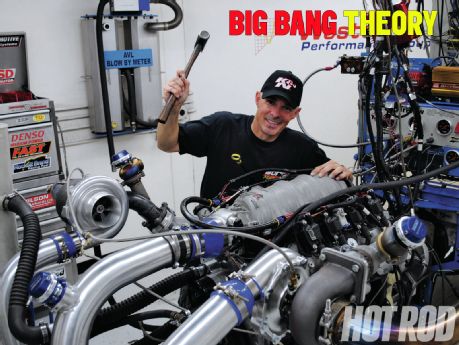
Hot Rod tries to find out what it would take to grenade a 5.3L LS truck engine. Their plan; take a stock block 5.3L junkyard engine, add a cam, Total Engine Airflow ported heads, a performance intake system, 75lb. injectors, and twin turbos. Then they would bolt it to a dyno and start adding boost until the engine came apart. The final result? They failed to break the engine, and that wasn’t the biggest surprise they got.
Read the article here!
http://www.hotrod.com/techarticles/hrdp_1109_stock_gm_ls_engine_big_bang_theory/
*****
Derek Cooper’s Mustang


89 Mustang
349 ci
Tea 225 Trickflow Highports
Trick flow Box r intake
Trickflow rocker arms
Trickflow rocker girdles
Trickflow pushrods
Trickflow rearend girdle
F1x procharger
Derek races in a heads up series in Denver Co. He has been awarded the Street Limited Championship for both 2011 and 2012. In 2012 he ran a best pass of 8.860 @ 158.54mph. Congratulations Derek!
*****
MustangII Weekend Warrior

Ed Pinegars’ weekend warrior project
The infamous Ford Mustang II is arguably the least liked of the Mustang family, in fact many Mustang enthusiast refuse to recognize it as a true Mustang. This is not the case for Ed Pinegar, when Ed looks at the Mustang II he sees a car that is an excellent base for building a weekend warrior. This light weight stallion has a reasonably wide wheelbase; this makes it a superb candidate for a tubbed-out rear end, and a tube chassis. It also has ample room between the front wheels for a healthy power plant, this is important because the original 4, V6, and V8, power plants were anemic, and that’s being kind. Enough said about the vehicle of choice, this article is about the power plant.
To get his Mustang II down the ¼ mile Ed opted to stick with a small block Windsor with lots of cubes. A 393ci stroker with a 14.8 to 1 compression ratio spinning at high RPM’s would make the car fun to drive. Of course that meant he would need a solid bottom end; so Ed went with a cast Scat Pro Comp 9000 crank, on which he hung Scat H Beam forged rods, and TrickFlow TFS-51704010 pistons. To spin high RPM’s with a stroker, the engine would need to breathe well; so Ed decided to run TEA prepped TFS\5170T010-C01 CNC ported 225 High Port heads, breathing through a ported Edelbrock Super Victor manifold, topped by a 1” Phenolic spacer, and a Quick fuel 950 carburetor. The valves are opened and closed by a custom ground camshaft, duration @ .050 268/276, total valve lift .721/.673 lift with a 112deg lobe separation. Exhaust duties are handled by custom made headers with 34.66” length 1.85” diameter tubes, and 17.33 length 3.51 diameter collectors.
The payoff;
509.8 foot pounds of torque @ 5,500 RPM
634.3 horsepower @ 7,200 RPM
But the real eye opener is the torque curve; this combination produces no less than 450 lb-ft of torque from 4,300 RPM all the way thru 7,300 RPM. How’s that for a fat flat carbureted torque curve?
Veteran racers talk about keeping the engine on the cam, that is to say keeping the engine in the RPM range where it produces the most power. With a torque curve that only varies by 59.8 lb-ft over a 3,000 RPM range that should be easy to do.
*****
Henson Motorsports 224.3MPH standing mile record setting run was achieved running a set of Total Engine Airflow prepped heads. Now you can watch the video here. http://youtu.be/OtsIBbIPW9A
The driver walked away from the amazing crash at the end of the video!
*****
Congratulations to Andreas Arthursson of Sweden on setting a new world record for a LS powered car; 6.73@205MPH http://youtu.be/ezIij-KPkVE
This twin turbo LS 427ci engine runs TEA/TFS 235cc cathedral port cylinder heads. Dyno pull 1948hp on 109 octane; however, the record run was made on 104 octane unleaded fuel as per Sweden’s laws.
*****
1-1-2010
GM High-Tech features a 9.89 second ‘2007’ Trailblazer SS running Total Engine Airlfow CNC ported Trick Flow cylinder heads.
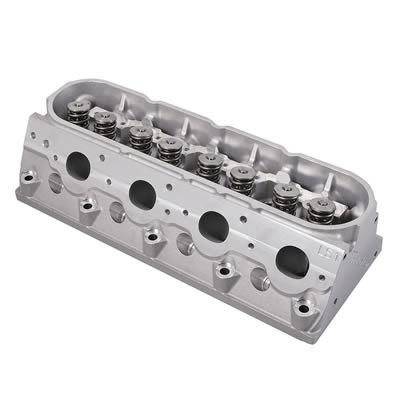
Get the full story at GM hightech!
*****
12-2-10
GM High-Tech 1000+hp ‘2010’ Camaro runs Total Engine Airlfow CNC ported GM LS3 cylinder heads. 
Get the full story at GM hightech!
*****
6-1-11
Muscle Mustangs & Fast Fords magazine builds a 700+hp 4.6L street bruiser using Total Engine Airflow’s ported PI heads.
See how they did it at Muscle Mustang & Fast Fords
*****
| Tech Articles; | |||||||||||||||||||||||||||||||||||||||||||||||||||||||||||||||||||||||||||||||||
|
Valve Lash Adjustment Procedures by Brian Tooley There are numerous ways to lash valves in an engine. We will discuss only Step #1 Find top dead center for piston #1 A lot of people think that if the timing pointer is on the balancer mark Step #2 Adjust the the lash of #1 cylinder This is where you have to determine the lash you will use. If it is a Step #3 Turn the crankshaft 90 degrees Turn the crankshaft 90 degrees or 1/4 turn to the next cylinder in the Step #4 Keep going Keep turning the crank in 90 degree increments and lashing the valves for Note: For you serious race car guys with gross duration figures in the 320 plus V8 Chevys/NON-LS
302HO and 351W
NON-H.O. 302 and 289
|
*****
Valvetrain Weights
by Brian Tooley, 2004
Note; It would not be possible to make this a complete list of all valvetrain components, these are some of the valvetrain combinations we use in GM LSX heads!
| Manufacturer | Part # | Part type | Diameter | Length | Stem Dia. | Material | Weight |
|---|---|---|---|---|---|---|---|
| Del West | Exhaust valve | 1.600 | 5.040 | 0.311 | Titanium | 62.3 | |
| GM | Z06 Exh valve | 1.550 | 8mm | 64.6 | |||
| Ferrea | F6232 | Exhaust valve | 1.550 | 8mm | 86.2 | ||
| Ferrea | F1021P | Exhaust valve | 1.600 | 8mm | 86.2 | ||
| GM | Stock exh valve | 87.3 | |||||
| Ferrea | F1893P | 94.6 | |||||
| Ferrea | F6267 | Exhaust valve | 1.600 | 0.100 | 96.0 | ||
| Ferrea | F6235 | Exhaust valve | 1.600 | 8mm | 97.6 | ||
| Ferrea | F1892P | Exhaust valve | 1.600 | 8mm | 98.9 | ||
| Del West | Intake valve | 2.055 | 5.040 | 0.311 | Titanium | 73.3 | |
| GM | Z06 Int valve | 2.000 | 8mm | 74.7 | |||
| Ferrea | F1022P | Intake valve | 8mm | 100.6 | |||
| GM | Stock int valve | 2.000 | 8mm | 101.1 | |||
| Ferrea | F1043P | Intake valve | 2.050 | 8mm | 103.7 | ||
| Ferrea | F6231 | Intake valve | 8mm | 108.8 | |||
| Ferrea | F6234 | Intake valve | 8mm | 112.4 | |||
| Ferrea | F6268 | Intake valve | 2.080 | 0.100 | 8mm | 113.4 | |
| GM | Stock locks | 2.5g | |||||
| Comp | 7 deg locks | 3.2g | |||||
| Comp | CC 611 | 10 deg 11/32 locks | 6.1g | ||||
| Comp | CC 614 | 10 deg 5/16 locks | 6.6g | ||||
| Manley | 13151-8 | 10 deg Bead lock | 7.1g | ||||
| Ferrea | S10048 | 1.260 Single Spring | 77.6g | ||||
| GM | 03′ Z06 Spring | 77.3g | |||||
| Comp | CC 918 | Single spring | 73.1g | ||||
| Comp | CC 987 | 1.440 Dual Spring | 119.3 | ||||
| Comp | CC 772 | Stock Dia Tit Ret (918) |
7.2 | ||||
| Ferrea | E11020 | Double Tit Ret | 9.4 | ||||
| Comp | 1.250 Tit Ret | 10.7 | |||||
| GM | Stock LS1/LS6 ret | 11.3 | |||||
| Victory | 1.550 Tit Ret | 14.2 | |||||
| Comp | CC 730 | 1.440 Tit Ret | 15.9 | ||||
| Comp | CC 776 | 1.440 Tit Ret | 16.4 | ||||
| Comp | 1.550 Tit Ret | 20.2 | |||||
| Comp | CC 749 | 1.550 Chromoly Ret | 35.2 |
**——————————————————————————————————————————————-**
Testimonial: